Summary
This article discusses methods to synchronize NIRx devices with multimodal systems like EEG and eye-tracking using hardware or software solutions. Hardware synchronization relies on 5V TTL triggers sent via parallel ports or tools like the Cedrus C-Pod, while software synchronization uses Lab Streaming Layer (LSL) in NIRStar. Additionally, NIRx offers an E-Prime® extension for seamless trigger communication in experiments.
We currently offer two solutions to integrate multiple modalities:
- Hardware solution (TTL-based)
- Software solution (LSL-based)
Hardware/TTL
Typically, you just need an objective timing marker or event marker to be acquired by both methods. Nearly all types of systems send or receive (or both) 5V TTL event markers. These are often sent over a parallel port, your network connection, or through something like a Cedrus C-Pod/Stimtracker.
To sync these triggers to the different systems we allow for two options. The first is to take a wired trigger signal and split it into multiple, yet still synced signals. This is done with our Parallel Port Replicator. This is an extremely simple tool to sync the events, however, for some modalities, this might not be an option, as some devices do not allow any hard-wiring.
Software/LSL
The alternative is to send an event marker over a linked network between the devices. To do this, you would need to sync your NIRx device to Lab Streaming Layer (LSL). This is done in the Data Streaming tab under Hardware Configuration in NIRStar. More information about LSL can be found in this article.
You will then need to figure out what presentation software you will be using to send the markers/triggers. We often work with PsychoPy and E-Prime.
E-Prime
This integration runs through Aurora fNIRS and includes package calls for LSL and Chronos triggering.
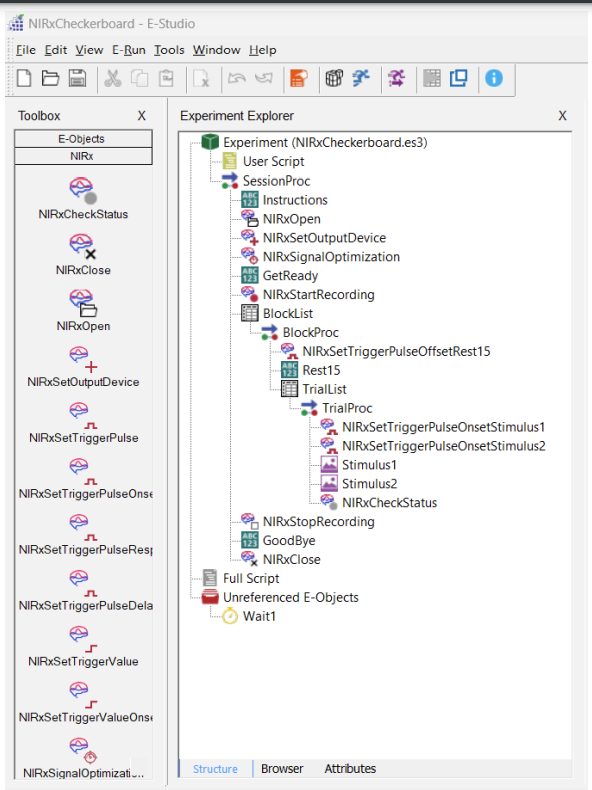
Figure 1: E-Prime GUI E-Studio displaying NIRx integration communicating triggers directly to Aurora fNIRS.
For more in-depth information on NIRx trigger protocols, refer to our NIRx Trigger Guide below.